Skype launched SkypeIn, which means you get a phone number people can call (before you could call 'real' phones but they couldn't call you), and more. This is brilliant for traveling. I use Skype regularly, and now I'll probably even use them more.
Information architecture in South Africa
Jason Hobbs from South Africa wrote me:
"I'm trying to create a network of information architects in south africa since they are near to impossible to find. Do you know of any or could you point me in the direction of people or institutions that could help me?
My interest is in increasing
+ awareness of IA
+ debate around IA
+ use of IA in commercial projects
+ research into IA
...in the context of south africa. There are real and unique challenges which we face in Africa with regards to the use of the internet and IA offers many solutions. I recently published this article in a marketing publication in south africa - you may find it interesting..."
So get in touch with Jason if you're interested in IA in South Africa.
The discussion on European IA continues, also on Lou's blog. If you post a comment on my blog, it won't show up immediatly (due to spam), but I will approve it. Sorry for that!
I'm doing a workshop here in Spain in 2 weeks, so I'll report back about the Spanish scene later :)
I am giving a workshop in Barcelona on Information Architecture on April 26: Curs de l'Arquitectura de la Informaci
Peter Bogaards has some more comments on the state of European IA.
A year ago, we were worrying about running out of bandwidth to host the videos we'd create as videobloggers. Today, there are TWO free and relatively reliable solutions for hosting free video: Google Video (Beta) - Video Upload Program and the Internet archive. That's pretty amazing, and we're not even talking Bittorrent yet.
Koranteng's Toli: Cultural Sensitivity in Technology. Fascinating stuff. (And some good comments on it.)
Page Description Diagrams, an interesting alternative to wireframes. I can see these work in certain environments.
Lou writes about how IA in Germany isn't really taking off.
I did an IA workshop in Brussels yesterday, and after talking with some of the people here I got the feeling that (please feel free to disagree with me here), in Europe, it depends on the country. In France, IA will probably never take off, at least the current style of US-centered IA. In Belgium, there are a few companies doing interesting IA/UX work, mostly for large clients like J&J and such. But as a field it's pretty unknown. I blame Belgian's lack of self-promotion :) In Holland, there is a bit more awareness (and historically more 'design' awareness) around IA, but also some confusion about what IA really is (there's another Dutch 'IA' organization with a very different take on what it means). I'll report back on Spain later, but I have noticed there is a bit of a UX scene there.
I am giving a full day Information Architecture Workshop next week Wednesday in Brussels (April 13, 2005).
Joho the Blog: Advice to young terrorists: "I have been pulled aside for special searches four out of the previous four times I've flown. Yesterday I asked the supervisor at the US Air desk at Logan Airport about it. He said that if you test positive for any two of the following three tests, the computer marks you for searching: A one way ticket, a ticket purchased in the past 24 hours, or paying by cash. On this particular trip, I met the first two criteria. Thus, I am a likely terrorist.
So, here's a word of advice to today's would-be terrorist: Splurge on the round-trip. Sure, it's going to cost an extra couple of hundred, but at the end of the trip, you're not going to care. Also, try to plan your murderous attack well in advance."
Ah, so that's what that is about :)
If IA and organization and classification are all around us, shouldn't you be able to learn something about international IA by closely looking around you at the world, especially when traveling?
I'm leaving for Spain today, expect a month of little blogging. Siesta. Yeah.
Wired News: We're a Hit in Manila! Now What?: "When Friendster first noticed that its social-networking service was gaining a strong following in the Philippines, company executives weren't sure how to capitalize on the unexpected popularity."
Not by putting ads, that's for sure. Interesting article.
Almost no online apps evolve well. Forum software is either geared towards small communities, or large ones. Categorization systems are geared towards lotsa content or just a bit of content. We really need our apps to take into account how usage of them evolves over time. Switches to more different views as things get more populated. Slowly adding functionality. Jotspot seems to understand that.
Wired News: Monster Fueled by Caffeine: "Delicious Monster is the Mac software company behind the hit Delicious Library, [...] the company's headquarters is a Seattle coffee house."
By the way, I gave in. After a few months of exclusively working with (the free) OpenOffice, I purchases Microsoft Office.
OpenOffice still rocks in regards to its file formats: save as PDF, save as Word, it's all easy and good. But it runs behind a bit in terms of usability - especially for the Powerpoint clone. The new release should fix much of that, but I couldn't wait.
Euromail: "North America and Europe are two continents divided by a common technology: e-mail. Techno-optimists assure us that e-mail—along with the Internet and satellite TV—make the world smaller. That may be true in a technical sense. I can send a message from my home in Miami to a German friend in Berlin and it will arrive almost instantly. But somewhere over the Atlantic, the messages get garbled. In fact, two distinct forms of e-mail have emerged: Euromail and Amerimail."
I have the same experience. After working for a few years in the US (and the UK), I am acculturated to their "loose" email use. When I'm emailing with European business partners, I always have to adjust my tone and formalism - because that's what they do.
translation eXchange: "Apparently half of all translations come from American books, and "Who Moved My Cheese?" is China's all-time best-selling translated work."
I bought who moved my cheese in India. A lot of the books for sale on the streets were american bestsellers.
Joho the Blog: [f2c] Lee Rainie: stats on who is online.
Joshua (from delicious): "After seeing my little project go from a small hobby to a large one and then consume all my waking hours, I've decided to quit my job and work on del.icio.us full time. I've given a lot of thought to how to make this happen, and ultimately decided that the best way forward is to take on some outside investment."
Good luck!
Gmail is down
When you live in a world where you feel compelled to share screenshots of a any one website going down, things are way out of hand. Dependency on Google? You betcha!

videobloggingweek2005 is rocking.
I got an invite for Yahoo 360 degrees, and spent 10 minutes on it. Looks alright. They seem to be pulling together a lot of the Yahoo stuff (fotos, groups, ...) through a social network (friends). From my brief look at it, the approach seems to make a lot of sense.
Briefly: We had an interesting chat with JD Lassica from Ourmedia on the videoblogging group (using IRC).
Also, there are weird problems with my blog that I'm not sure I can fix before leaving for Spain on Friday.
Joel on Software - The Road to FogBugz 4.0: Part II: "I have never been to Japan but my father, a linguist, once told me the story of the train station in Tokyo, where the announcements were made in Japanese and English. You would hear four or five minutes of nonstop Japanese and then the English translation would be "The train to Osaka is on platform 4." It seems that in Japanese there is simply no way to say something that simple without cosseting it heavily in a bunch of formal etiquette-stuff."
ThoughtStorms: WikiMinion/FightingSpamEverywhere: a tool that goes through public wikis and remove spam. In other words, an anti spambot bot. Brilliant and useful.
Join the IA Institute for free!
This isn't very well know, but if you are an information architect in Afghanistan, Albania, Algeria, Angola, Armenia, Azerbaijan, Belarus, Bangladesh, Belize, Benin, Bhutan, Bolivia, Bosnia and Herzegovina, Bulgaria, Burkina Faso, Burundi, Cambodia, Cameroon, Cape Verde, Central African Republic, Chad, China, Colombia, Comoros, Congo,Côte d'Ivoire, Cuba, Ecuador, Egypt, Guatemala, or a whole bunch of other countries, and if you are a student, you can join the IA Institute for free, and get access to their great mailing list, job boards and all that.
And if you're not, joining is a great deal anyway.
Stephen's Web ~ by Stephen Downes ~ Interesting talk.
This is a test: reposting a vlog entry.
Keeping Found Things Found: "The goal of this study is to understand better the ways in which people manage information for subsequent re-access and re-use." Donna should find this interesting :)
Hoe begin ik een gratis videoblog?
This is a Dutch translation of freevlog.
Stap 1 â Een gratis blog
Op deze pagina leggen wij uit hoe je een GRATIS videoblog kan beginnen. We gaan een gratis blog opzetten, en gratis video hosting bij het Internet Archive.
Als je al een blog hebt kun je deze stap overslagen. Eerst moeten we een gratis blog opzetten. Een blog is gewoon een soort website. Ga naar Blogger.com, start een gratis account. Blogger is in het Engels- hopelijk maken ze snel een Nederlandstalige website. Start een blog, en schrijf je eerste post.
Here is the link to my tutorial on how to set up a free Blogger blog. (Engels)
Stap 2: een video.
OK, nu we ons blog hebben, gaan we er een video op zetten. Ik veronderstel dat je al een filmpje klaar hebt.
De beste plaats om je video te bewaren is het Internet Archive. Het internet archive is een gratis host, het is een non profit gestart door een internet billionaire. Het is een goede website. Dus ga naar het internet archive en start een gratis account. Doe het nu!
Hier is een voorbeeld van een filmpje:
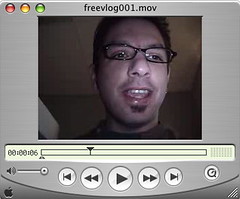
Dan moet je CCPublisher downloaden.
CCPublisher is een programma dat het gemakkelijk maakt om videos naar het Internet Archive te sturen.
Als je nog geen filmpje hebt, maak er een. Houd het simple, gewoon zeggen âdit is mijn eerste videoâ? is genoeg. Wanneer de video af is, start de CCPublisher en stuur de video naar het Archive. Het duurt ongeveer een dag voor het in feite beschikbaar is. Dus je wacht een dag, en dan ga je naar je account op de website van het internet archive en je copieert de URL. Als je de URL hebt ga je naar je blog en je schrijft een post met die URL.
Stap 3 â Een RSS feed met enclosures
Nu dat je een videoblog hebt, moet je zorgen dat mensen je video kunnen vinden. Je blog heft een RSS feed, maar wat je eigenlijk nodig hebt is een RSS feed met enclosures. Dit maakt het mogelijk voor mensen die tools zoals ANT of Mefeedia gebruiken om je videos te vinden.
Om dit te doen neem je je Blogger RSS feed en ga je naar Feedburner.
Hier is meer uitleg (Engels) over Feedburner.
OK, nu dat je je Feedburner feed hebt, kun je je feed toevoegen aan videoblogger directories. De Mefeedia directory is voorlopig de grootste. Kopieer je Feedburner feed URL en voeg hem toe aan de Mefeedia directory.
ANT heeft nog geen directory, ondertussen kun je in del.icio.us je Feedburner URL toevoegen met de tag âantfeedsâ?.
Ga ook naar videoblogging.info en geef je informatie in.
Stap 5 - Maak deel uit van de community
Nu ben je een videoblogger!
Je kun deel uitmaken van de internationale discussie door lid te worden van the videoblogging Yahoo group.
Tenslotte, zeg het volgende luidop:
Ik, __________, beloof regelmatig videos te sturen naar mijn blog, ook al heb ik het druk op mijn werk en niet echt tijd, en ook al voel ik me alsof ik eigenlijk niets interessants te zeggen heb. Ik beloof ook tenminste 5 mensen uit te leggen wat videobloggen is en waarom het interessant is.
En je kunt linken naar dit artikel.
About being "first to market" with new functionality. I just realized something. Sometimes you need to roll out new functionality quickly, before the competition does. The reason is not so much to lock in users or to get early adopters, it is to influence practices of technology use. Because new technology gets shaped by its users as much as by its designers. If you can join that dance with your users early on, you will shape each other, and in that way set examples for the future and shape the world.
(via the fcd) Now online: check out Ranganathan's original Colon classification.
Anyone has experience with versionhost
?
I will be giving an Information Architecture Workshop in Brussels, Belgium on April 13. I'm excited about it - I hope to give quite a few workshops in Europe during the coming year. You don't need to be an information architect to attend, or even be that familiar with the field, but it will be an intense workshop - I plan to cover a lot of ground. If you *are* an IA, you should learn quite a bit too. I also have a workshop in Barcelona coming up - more details on that later.
the trouble with translation on Flickr - Photo Sharing!: Christina's example of semantic overlap.
Waw, by searching A9 for "peter van dijck", I found 3 books I am mentioned in (apart from my own). 3! I didn't even know! Amazing.
You know that smartmob thing I was part of? Improv Everywhere Mission: Look Up More
Brightcove (presentation) looks like ANT (desktop aggregating) + Ourmedia (storage, web service) + Mefeedia (tagging, web service). I'm not sure doing all things at once is going to be the winning approach. At least in our approach, things can be swapped out and compete (there can be more than one of each element). We'll see.
The sigia list is thinking of folksonomies as on a continuum:
Tanya has a mp3 recording of the 'Sorting Out Social Classification' panel.
"Dear Mr. Van Dijck,
We need to restock your book Information for Designers. Unfortunately, I cannot locate the name of the publisher ..." I think this is good news :)
Donna: Maybe we do need IA research. Woohoo, we have a convert ;) Yes, we need research. Or we'll end up like the knowledge management guys. (No offense.) The amount of stuff we don't know yet is staggering.
I helped out a bit with the Ourmedia metadata work, and they were nice enough to label me "metadata nerd" on their project team page. Chech out Ourmedia. It's a brilliant and worthwhile project.
Something I just realized: in the history of science, very little research has been done into research methods. What works, what doesn't and why. I actually met someone in London once who was starting up research into research methods as an academic discipline - can't find his name now though. Fascinating stuff.
The same applies to IA. Sure, we have cardsorts and such, but not a lot of insight, really, in what works, and especially why. Rashmi (academic with a superpractical bent) and Donna are two of our best thinkers in that field.
Related: my research agenda for IA post.
O'Reilly Network: Hypermedia: Why Now?: "my hunch is that we'll soon see a tidal wave of creative work."
MSNBC - Ready for your close-up? Here come the vlogs And yes they mention my baby.